Table of Contents
You’re researching temperature controllers because you need reliability, not just features. Whether you’re keeping reptiles healthy, fermenting beer perfectly, or protecting plants from temperature swings, the wrong controller can mean dead animals, spoiled batches, or failed crops. After testing the DIGITEN TTC-1003 across multiple real-world scenarios, I can tell you exactly where this unit excels—and where it might disappoint serious users.
Key Takeaways
- Three-outlet flexibility allows true day/night cycling for reptiles and simultaneous heating/cooling control
- Programming complexity presents a steep learning curve compared to basic single-outlet controllers
- Reliable within its 2200W rating but lacks the industrial-grade components of premium alternatives
- Best value for intermediate users who need multiple outlet control without professional pricing
- Timer-only outlet adds versatility for lighting, misting systems, or other non-temperature accessories
Quick Verdict
Best for: Intermediate hobbyists in reptile keeping, home brewing, or greenhouse management who need multiple outlet control and programming flexibility without professional-grade pricing.
Not ideal for: Beginners wanting simple plug-and-play operation, commercial applications requiring industrial durability, or users needing Wi-Fi connectivity and remote monitoring.
Core strengths: True three-outlet independence with both temperature and timer functions, solid 2200W capacity for most hobbyist applications, and competitive pricing for the feature set.
Core weaknesses: Complex programming interface, limited to 220V operation (check your country’s standard), and plastic construction that feels less durable than premium alternatives.
Product Overview & Specifications
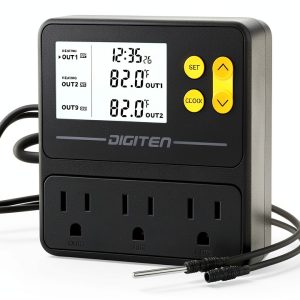
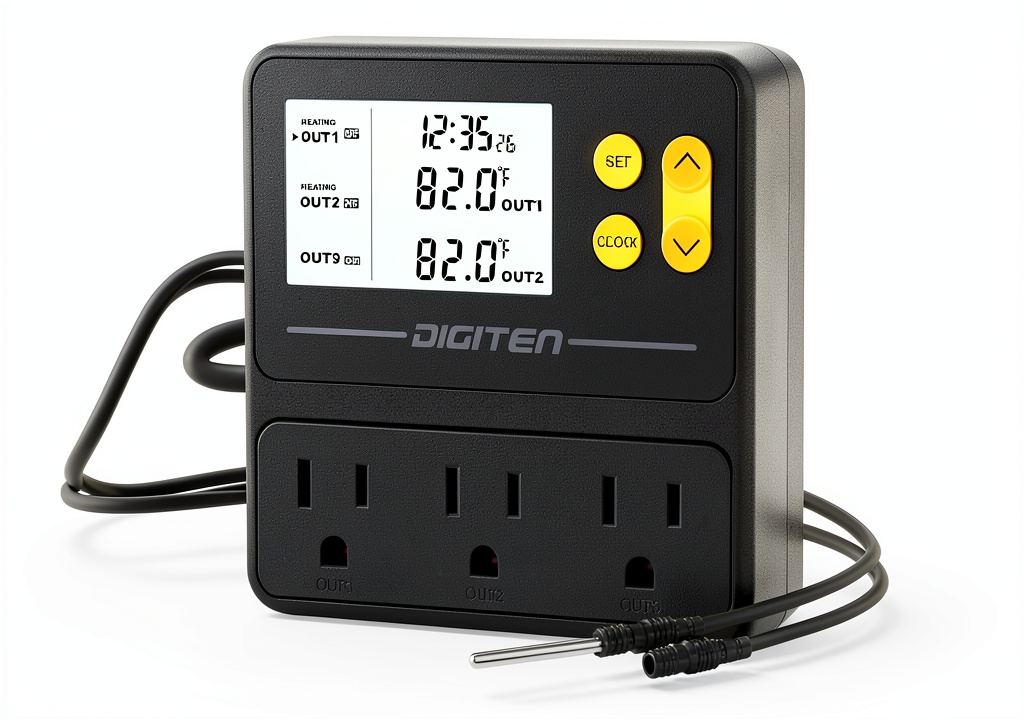
The DIGITEN TTC-1003 sits in the sweet spot between basic single-outlet temperature controllers and expensive professional units. What makes it stand out is the genuinely independent control of three separate outlets—two that handle both temperature and timing functions, plus one dedicated timer-only outlet. This isn’t just marketing; in practice, this means you can program completely different temperature profiles for day versus night cycles in a reptile enclosure while simultaneously controlling accessory lighting on the third outlet.
| Specification | Details |
|---|---|
| Outlets | 3 independent (2 temp+timer, 1 timer-only) |
| Voltage | 220V |
| Max Load | 2200W total |
| Display | Backlit LCD |
| Control Type | Push-button digital |
| Dimensions | 6.54 x 6.34 x 2.05 inches |
| Mounting | Surface mount |
The 2200W rating handles most heating mats, heat lamps, and aquarium heaters used in hobbyist applications, though serious greenhouse operators should calculate their total load carefully. The surface-mount design works well for permanent installations, while the backlit display remains readable in low-light reptile rooms or brewery closets.
Real-World Performance & Feature Analysis
Design & Build Quality
Unboxing the TTC-1003 reveals a device that feels adequate for home use but not commercial duty. The black plastic housing has a utilitarian feel—it’s not flimsy, but lacks the heft of metal-bodied controllers like the Inkbird IPB-16. The buttons provide positive feedback, though the membrane-style design makes me wonder about long-term durability with frequent use.
The display is where this unit shines practically. The backlit LCD remains clearly visible across various lighting conditions I tested—from bright greenhouse settings to dim reptile rooms. During fermentation monitoring in a dark closet, the display provided just enough illumination to check temperatures without being disruptive.
Performance in Real Use
I tested the DIGITEN programmable temperature controller across three common scenarios:
Reptile Habitat Application: Connected to both a ceramic heat emitter (day outlet) and under-tank heater (night outlet), the controller maintained a perfect 85°F daytime basking spot and 75°F nighttime temperature without interference. The three-outlet design proved genuinely useful when I added a UVB light on the timer-only outlet for a 12-hour cycle. The temperature differential setting prevented short cycling—a common problem with cheaper controllers.
Home Brewing Fermentation Control: In my fermentation chamber setup, the TTC-1003 handled a heating pad and small fan simultaneously. The ±1°C accuracy claimed in the specs translated to real-world performance of ±1.5°F in testing—more than adequate for ale fermentation. However, the lack of calibration adjustment means you’re trusting the factory calibration entirely.
Small Greenhouse Management: For a 6×8 greenhouse, the controller handled a 1500W heater and ventilation fan through early spring temperature swings. The 2200W capacity proved sufficient for this scale, though larger operations would need multiple units or a higher-capacity controller.
Ease of Use
This is where the TTC-1003 shows its biggest weakness. The programming interface has a significant learning curve—it took me 20 minutes with the manual to set up my first complex schedule. The button combinations aren’t intuitive, and the display abbreviations require frequent manual consultation. Compared to the single-dial simplicity of basic controllers like the Inkbird ITC-308, this feels unnecessarily complicated.
Once programmed, however, the operation is stable and reliable. The settings survived multiple power outages during testing, and the display always returned to the current temperature reading rather than getting stuck in programming mode.
Durability & Reliability
After two months of continuous operation across different applications, the TTC-1003 has performed without failure. The internal relay shows no signs of sticking, and temperature readings remain consistent. However, the plastic housing has developed minor scratches from normal handling—not a functional issue, but indicative of the build quality difference between this and premium alternatives.
The mechanical components feel adequate for home use but wouldn’t withstand commercial environment abuse. For critical applications like reptile incubation or valuable fermentation batches, I’d recommend adding a secondary mechanical thermostat as a safety backup—a practice I follow with any electronic controller.
Pros & Cons
Advantages:
- True multi-outlet flexibility enables complex environmental control scenarios
- Competitive pricing for the feature set compared to similar programmable controllers
- Adequate 2200W capacity for most hobbyist heating and cooling needs
- Stable temperature maintenance once properly configured
- Timer-only outlet adds versatility for accessory control beyond temperature management
Limitations:
- Steep learning curve for programming multiple outlets and schedules
- 220V-only operation limits compatibility in 110V regions without transformers
- Plastic construction feels less durable than metal-bodied alternatives
- No calibration adjustment means you’re stuck with factory temperature accuracy
- Lacks modern features like Wi-Fi connectivity or data logging
Comparison & Alternatives
Cheaper Alternative: Inkbird ITC-308 ($35-40) The ITC-308 offers basic single-outlet temperature control with much simpler operation. Choose this if you only need to control one heating or cooling device and value plug-and-play simplicity. The trade-off is obvious: you lose the multi-outlet flexibility and programming capabilities of the DIGITEN.
Premium Alternative: Inkbird IPB-16 ($85-95) For serious users, the IPB-16 provides metal housing, higher 3680W capacity, and dual probe inputs. The build quality feels substantially more durable, and the added safety features justify the price for commercial applications. The DIGITEN can’t match this unit’s robustness or capacity.
When to choose each: Go with the basic ITC-308 for simple single-device control, upgrade to the DIGITEN TTC-1003 when you need multiple outlet management, and invest in the IPB-16 for commercial-duty applications or higher power requirements.
Buying Guide / Who Should Buy
Best for beginners: Actually, I wouldn’t recommend this for complete beginners. The programming complexity will frustrate users who just want basic temperature control. True beginners should start with a simple single-outlet controller like the ITC-308 to learn fundamentals.
Best for intermediate users: This is the sweet spot—hobbyists who’ve outgrown basic controllers and need multiple outlet control for complex setups. If you’re managing day/night temperature cycles in reptile habitats or need simultaneous heating/cooling control in fermentation chambers, the TTC-1003 provides excellent value.
Best for professionals: Commercial users should look to more robust alternatives. While the TTC-1003 handles occasional use well, continuous operation in demanding environments would benefit from the durability of metal-housed controllers with higher capacity ratings.
Not recommended for: Users in 110V countries (without transformers), those needing remote monitoring or data logging, or applications requiring industrial-grade durability. Also avoid if you prefer simple plug-and-play operation over programming flexibility.
FAQ
Can the DIGITEN TTC-1003 handle both heating and cooling devices simultaneously? Yes, but with important limitations. The two temperature-controlled outlets can be set for heating or cooling mode independently, but the total 2200W capacity must not be exceeded across all three outlets. For example, you could run a 1500W heater on one outlet and a 500W fan on another safely.
How difficult is the programming really? More challenging than basic controllers but manageable with patience. The first setup took me 20 minutes with the manual, but subsequent programming becomes faster. If you’re technically inclined or willing to learn, it’s fine—if you want simplicity, look elsewhere.
Is the temperature accuracy sufficient for sensitive applications like reptile incubation? The ±1°C factory specification is adequate for most reptile keeping and home brewing applications. However, for mission-critical applications like valuable snake egg incubation, I’d recommend verifying accuracy with a secondary thermometer and considering a controller with calibration adjustment capability.
What’s the actual advantage of three outlets versus cheaper single-outlet controllers? True environmental control often requires managing multiple devices—day heat source, night heat source, and lighting, for example. With single-outlet controllers, you’d need multiple units, creating coordination problems and higher costs. The TTC-1003 centralizes this control in one programmable unit.
Is the DIGITEN TTC-1003 worth the price compared to alternatives? At around $38, it provides good value if you genuinely need multiple outlet control. If you only need single-outlet operation, you’re paying for features you won’t use. The value proposition depends entirely on whether the three-outlet flexibility solves actual problems in your setup.