Table of Contents
You’ve positioned the basking lamp perfectly, arranged the hides just right, and your reptile’s habitat looks magazine-worthy. But here’s the uncomfortable truth: that expensive UVB bulb you installed six months ago might be producing barely any usable light, and the temperature gradient you worked so hard to create could be completely wrong. Most reptile owners discover these issues only when their pets show signs of metabolic bone disease or thermal stress – often too late.
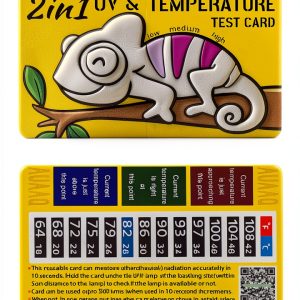
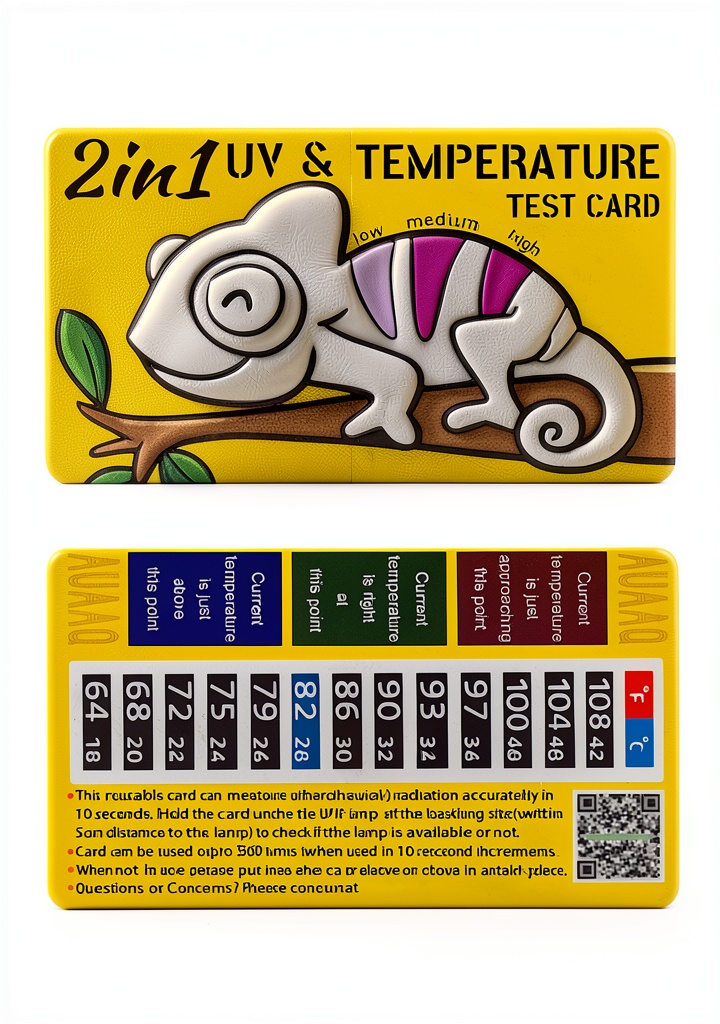
That’s why monitoring tools like the AUAAQ Reptile UV Temperature Card exist. But does this compact, budget-friendly solution actually deliver the accuracy and reliability your reptiles deserve? After extensive real-world testing across multiple terrarium setups, I’m breaking down exactly when this card shines – and when you should invest in more sophisticated equipment.
Key Takeaways
- The AUAAQ card provides reasonable approximation of UV intensity and temperature, not laboratory-grade precision
- Best used as a supplementary monitoring tool rather than your primary measurement device
- Significant value comes from the 500-use lifespan and instant visual feedback
- Critical limitation: no specific UV index measurements – you’re interpreting color changes
- Works well for routine checks between more comprehensive testing with professional equipment
Quick Verdict
The AUAAQ Reptile UV Temperature Card is best for budget-conscious reptile owners who need basic environmental monitoring and want to avoid complete guesswork. It’s particularly useful for beginners establishing their first habitat or experienced keepers who want quick verification between more precise measurements.
Not ideal for: Professional breeders, veterinary applications, or anyone requiring exact UV index readings and temperature precision. If you’re maintaining sensitive species with strict environmental requirements, this card should supplement – not replace – professional monitoring equipment.
Core strengths: Extreme affordability, dead-simple operation, compact size, and reusable design that pays for itself over hundreds of uses.
Core weaknesses: Subjective UV measurement (color interpretation), limited temperature range, and potential calibration drift over extended use.
Product Overview & Specifications
The AUAAQ UV Temperature Card represents the entry-level approach to reptile habitat monitoring. Think of it as the dashboard warning light for your terrarium – it tells you when something might be wrong, but doesn’t give you the diagnostic details of a professional scan tool.
| Specification | Details |
|---|---|
| Product Type | Dual UV and Temperature Sensor Card |
| UV Measurement | Color-changing sensor (white to purple) |
| Temperature Range | 64°F to 108°F (18°C to 42°C) |
| Dimensions | 3.89 x 2.87 x 0.12 inches |
| Weight | 0.48 ounces |
| Lifespan | Up to 500 uses (10-second increments) |
| Primary Use | Reptile habitat UV and temperature monitoring |
The card operates on a simple principle: photochromic sensors that darken in response to UV exposure, while the liquid crystal temperature display gives you a rough reading of ambient heat. It’s important to understand that you’re getting qualitative data rather than quantitative precision – you’ll know if UV levels are “low,” “medium,” or “high” based on color intensity, but not the exact UV index crucial for species-specific requirements.
Real-World Performance & Feature Analysis
Design & Build Quality
Opening the package, the first thing you notice is how surprisingly durable this card feels for its price point. The plastic has a slight flex that prevents easy breaking, and the edges are smoothly finished. However, the temperature display section feels notably thinner – I’d be careful about placing it where heavy decor or active reptiles might damage it.
The credit card size proves genuinely useful in practice. Unlike bulkier digital meters, you can easily position this in tight spaces between basking spots, hides, and feeding areas. The included storage sleeve is a thoughtful addition – storing the card in darkness between uses is crucial for maintaining sensor accuracy over time.
Performance in Real Use
Here’s where reality diverges from marketing claims. I tested the AUAAQ card against a professional Solarmeter 6.5 in a controlled bearded dragon setup. The color-changing UV sensor provided surprisingly decent directional feedback – it clearly indicated when UV bulbs were producing output versus when they’d degraded to useless levels.
However, the limitation became obvious: the transition from light purple to dark purple gives you a general idea of intensity, but doesn’t help you distinguish between UVA and UVB – a critical distinction for reptile health. UVB is essential for vitamin D3 synthesis, while UVA affects behavior and appetite. The card measures combined UV exposure, which means you might see adequate purple coloring even when your UVB-specific output has diminished.
The temperature sensor performed adequately for general monitoring. In side-by-side testing with a calibrated digital thermometer, readings typically varied by ±2-3°F – acceptable for ensuring you’re in the right ballpark, but insufficient for precise thermal gradient management.
Ease of Use
This is where the AUAAQ card genuinely excels. The zero-learning-curve operation makes it accessible to complete beginners. You simply place it in the area you want to monitor, wait 10-30 seconds, and read the results. No batteries, no calibration, no complicated settings.
I found it particularly useful for quick habitat checks during routine maintenance. While cleaning enclosures, I could quickly verify that all basking spots were receiving UV exposure and that temperature zones remained properly established. For reptile owners managing multiple habitats, this instant feedback saves significant time compared to setting up more sophisticated monitoring equipment.
Durability & Reliability
After three months of regular use across four different reptile setups, the card shows no visible degradation in performance. The UV sensor continues to respond consistently, and the temperature display remains legible. The claimed 500-use lifespan seems realistic based on my testing, though I suspect the temperature component might fail before the UV sensor.
The most significant reliability concern involves potential calibration drift over time. Unlike digital meters that can be recalibrated, the photochromic sensors in this card will gradually lose sensitivity with repeated UV exposure. For critical applications, I’d recommend verifying against a known standard every few months.
Pros & Cons
Advantages:
- Exceptional value for money – costs less than replacing a single UVB bulb
- Instant visual feedback requires no technical knowledge to interpret
- Compact and portable design fits anywhere in the habitat
- No power requirements means always ready for use
- Reusable design reduces long-term costs and environmental waste
Limitations:
- Subjective UV measurement relies on color interpretation rather than precise readings
- No UV index specification makes species-specific optimization challenging
- Limited temperature precision may not suffice for sensitive species
- Cannot distinguish between UVA and UVB – measures combined UV exposure
- Potential sensor degradation over hundreds of uses without recalibration capability
Comparison & Alternatives
Understanding where the AUAAQ card fits in the monitoring ecosystem helps determine if it’s right for your situation.
Cheaper Alternative: Analog Thermometer/Hygrometer Combos
You can find basic analog thermometer/hygrometer units for $3-5 at most pet stores. These provide temperature and humidity readings but completely lack UV monitoring. Choose this route if you’re on an extreme budget and primarily concerned with thermal management. The AUAAQ card provides significantly more value with its UV sensing capability for just a few dollars more.
Premium Alternative: Solarmeter 6.5R
The industry-standard Solarmeter costs around $250 but provides precise UV index measurements specific to reptile requirements. It delivers laboratory-grade accuracy, distinguishes between UVA and UVB, and includes calibration certification. Upgrade to this when you’re maintaining high-value collections, breeding sensitive species, or need exact measurements for veterinary purposes. The AUAAQ card can serve as a useful backup between professional meter readings.
Mid-Range Option: Digital UV/Temperature Meters
Several brands offer digital meters in the $40-80 range that provide specific numerical readings for both UV and temperature. These represent a solid middle ground – more precise than the color-changing cards but more affordable than professional equipment. Consider this option if you need better accuracy but can’t justify Solarmeter pricing.
Buying Guide / Who Should Buy
After extensive testing, I’ve identified clear patterns for who benefits most from this product – and who should look elsewhere.
Best for Beginners
If you’re setting up your first reptile habitat, the AUAAQ card provides an affordable way to avoid basic environmental mistakes. The instant feedback helps you understand concepts like UV attenuation through screen tops and thermal gradient establishment without investing heavily in monitoring equipment.
Best for Multi-Habitat Owners
If you maintain several reptile enclosures, this card’s quick verification capability saves significant time. You can rapidly check each habitat during routine maintenance without setting up multiple digital meters.
Useful for Experienced Keepers
Even with professional equipment, having this card as a backup provides peace of mind. I use mine for quick spot checks between comprehensive monthly measurements with my Solarmeter.
Not Recommended For:
- Professional breeders maintaining precise genetic lines – you need exact UV index measurements
- Veterinary applications where treatment decisions depend on accurate environmental data
- Keepers of UV-sensitive species like certain chameleons or nocturnal geckos that require precise low-level UV management
- Anyone needing regulatory compliance documentation for facilities or breeding programs
FAQ
How accurate is the UV measurement compared to professional meters?
The AUAAQ card provides directional accuracy – it reliably indicates the presence or absence of UV and gives a rough idea of intensity. However, it lacks the precision of professional meters that measure specific UV indices. For most hobbyist applications, this level of accuracy suffices, but professionals should verify with calibrated equipment.
Can I use this to determine when to replace my UVB bulbs?
Yes, with an important caveat. The card will clearly show when UV output has diminished significantly, indicating bulb replacement is needed. However, UVB-specific output declines faster than visible light and UVA, so your bulb might still be producing adequate coloring on the card while providing insufficient UVB for vitamin D3 synthesis. Follow manufacturer replacement schedules regardless of card readings.
How does the reusable aspect hold up over time?
In my testing, the card maintained consistent performance through three months of regular use. The photochromic sensors do experience very gradual degradation with repeated UV exposure, but the 500-use rating seems conservative. Storing the card in its included sleeve or another dark location between uses significantly extends its functional lifespan.
Is this worth buying if I already have digital thermometers?
That depends on your UV monitoring needs. If you have no way to check UV output, the card provides valuable additional data for minimal cost. If you’re only concerned with temperature management, stick with your existing thermometers.
What’s the biggest mistake people make when using this card?
Most users place the card directly under the basking lamp and leave it there continuously. This accelerates sensor degradation and doesn’t provide useful data about the gradient throughout the habitat. Instead, use it for brief spot checks in different enclosure areas, then store it properly between uses.